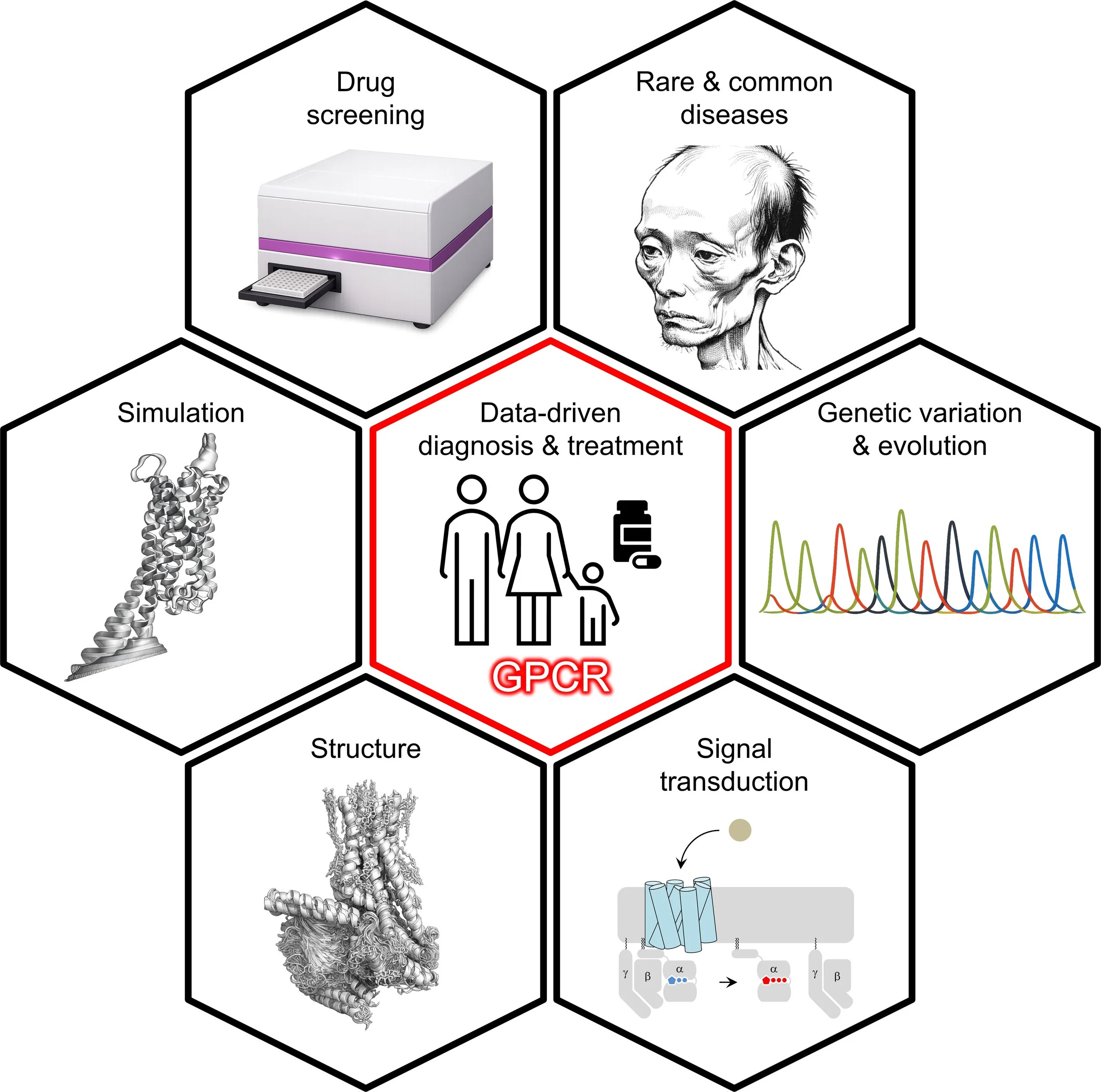
We combine quantitative live-cell signaling, structural analysis, and functional genomics to decode the molecular logic of GPCR signaling—how receptors translate ligand binding into selective G protein activation, and how genetic variants and drugs reprogram this process in health and disease—providing a foundation for mechanism-guided therapeutics.
Representative Publications
DRD1-driven infantile dystonia: towards a mechanism-informed framework for GPCR receptoropathies.
Brain (2026)
Identifies biallelic DRD1 variants as a cause of infantile dystonia and shows how variant-specific mechanisms can inform targeted pharmacological rescue.The structure and function of the ghrelin receptor coding for drug actions.
Nature Structural & Molecular Biology (2025)
Combines cryo-EM and quantitative signaling to reveal how ligand structure, signaling bias, and genetic variation shape drug action at the ghrelin receptor.Rules and mechanisms governing G protein coupling selectivity of GPCRs.
Cell Reports (2023)
Defines the coupling profiles of 124 GPCRs and uncovers structural rules that govern selectivity among G protein subtypes.Diversity of the Gβγ complexes defines spatial and temporal bias of GPCR signaling.
Cell Systems (2021)
Demonstrates that Gβγ composition controls the strength, kinetics, and subcellular localization of GPCR signaling.A global map of G protein signaling regulation by RGS proteins.
Cell (2020)
Maps the selectivity of all canonical RGS proteins across Gα substrates, revealing molecular and evolutionary rules governing signal termination.Molecular deconvolution platform to establish disease mechanisms by surveying GPCR signaling.
Cell Reports (2018)
Introduces a scalable platform that classifies disease variants by the distinct molecular mechanisms through which they disrupt GPCR signaling.Distinct profiles of functional discrimination among G proteins determine the actions of G protein-coupled receptors.
Science Signaling (2015)
Establishes live-cell G protein profiling and shows that each GPCR generates a distinctive fingerprint of coupling efficacy and activation kinetics.
Funding
Structural and Functional Studies of the GPCRome
NIH/NIGMS R35GM156391
Masuho (PI)
07/01/2025-06/30/2030
The major goal of this project is to elucidate the mechanisms of G protein selectivity in GPCR signaling, with the ultimate aim of informing the development of more selective and effective GPCR-targeted therapies.
Not by weaving complex theories, not by building speculative philosophies, do I desire a deep understanding of simple and beautiful truths.
増保 生郎
Ikuo Masuho, PhD
E-mail: Ikuo.Masuho@SanfordHealth.org
ポスドク・スタッフサイエンティスト募集
ご興味のある方は、ぜひお気軽に直接メールでご連絡ください。詳細についてご説明させていただきます。